
Steta Publishers
  • Home
  • About
  • Work
  • Twitbits
  • Blog
Steta Publishers was a writing and brand language consultancy that ran from 2012 to 2016. We are no longer available for projects. Our founders now work here and here. 

We Stand Corrected

14/3/2016

0 Comments

 
One of previous blog posts started with the line ‘At Steta, one of our proofreaders is a retired gentleman.’

The same gentleman (bless him), has brought to our notice the fact that ‘retired gentleman’ is misleading. It implies he was a gentleman in the past, and is no longer one. The line should read:
'At Steta, one of our proofreaders is a retired Government employee and a gentleman...' OR
'At Steta, one of our proofreaders is a gentleman who is a retired Government employee...'
 
It is these subtle nuances of language that can make the difference between good writing and almost-perfect writing. The English language is flexible enough to allow many different ways to express the same thought. It is essential, however, to see that the sentence remains true to its intended meaning.
 
If you happen to notice any aspects of language on this website that could be improved, please do let us know.

By Armeen Kapadia
0 Comments

The Mental Thesaurus

12/9/2015

0 Comments

 
Picture
At Steta, one of our proofreaders is a retired gentleman. We’ve noticed a subtle difference between his and our own proofreading skills. People of that generation carry a dictionary and thesaurus with them at all times, inside their heads. The rest of us sometimes tend to resort to double-checking things with online resources. This makes life easy, but it’s also making us terribly dependent on readymade solutions. For instance, someone asks me synonyms of ‘nice’. I can rattle off some, but after a while I’m tempted click my way to an online Merriam Webster or Roget’s. The online medium is a great support system, but we have to be  careful not to become dependent on it.

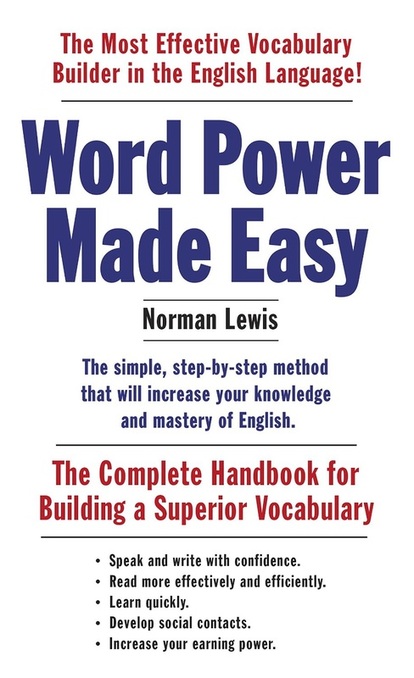
It was actually a book that got me thinking about all this. It’s called Word Power Made Easy by Norman Lewis. Each chapter is a series of explanations and exercises, and he makes learning vocabulary a joy. You’ll actually look forward to reading a chapter a day (that’s what he advises), and you only need give it half an hour, at the most. His writing style is conversational, honest and encouraging. The exercises are designed with just the right number of new words that stick in your head, and leave you with a sense of accomplishment and joy at learning something new. He brings to light root words and their meanings, so that we’re not stumped when we come across a rarely used word.

Whether you’re a writer or not, having command over vocabulary, grammar and spelling is always an advantage. This brilliant book is one of the best investments you’ll ever make. Norman Lewis was an author, grammarian, lexicographer
, and etymologist (I learned the exact meaning of that last word in his book). He’s as brilliant a teacher as he is a writer, and this book is a great way to build that dictionary/thesaurus in your head. 

By Armeen Kapadia
0 Comments

Is it double or single inverted commas?

23/11/2014

0 Comments

 
I remember my English teacher drilling it into our heads, “It is double inverted commas for direct speech. And always remember to close the quotation marks.” I don’t remember much else from those English grammar classes but this one thing has somehow stayed with me. 

Of all the punctuation marks, I have a soft corner for these little hook-like marks. To me, they have a distinct personality and I’ve always felt they stamp their authority in print because people love to read conversations. After all, conversations must necessarily begin and end with these little hook-like characters. “What a presence they have, these little creatures”, I used to think. 

In those days, we did not know that there are two brands of English – British and American. Of course, there are many brands of English spoken across the world – from the Hinglish (Indian English) to Singlish (Singaporean English) to Australian English (we get a taste of this English when Australian cricketers speak in post-match press conferences). If ever the Chinese learn to speak English, I’m not sure what that brand will be called (Chin Ling English?). In any case, the two broad standards of English – at least written English – continue to be the British and the American standards. 

Working on a book edit recently, all stake holders agreed that British English would be the standard to follow. As I went through the 200-odd page book, I found the inverted commas popping up every few pages. You see, the author had mistakenly inserted single inverted commas for all conversations. Diligently I added comments for the author each time I saw the single inverted commas – trusting my education and trusting the fact that what we learnt at school was in fact, British English. 

Imagine my utter disbelief when the author pointed out that British English used single inverted commas and American English used double inverted commas. “No, no, no!” I shook my head, “that’s not true.” I was smug in my knowledge that it was the other way around. To confirm my belief, I dug out some books from my book shelf. British authors – old and new – Enid Blyton, Colin Thruborn, Salman Rushdie. Book after book, I saw that the poor double inverted comma had lost out to its singular cousin. When did this happen? I have no clue. Perhaps, some publishing house somewhere decided that thousands of reams of paper could be saved by making that tiny adjustment in publishing. Perhaps, that’s true. In any case, these are matters of style and not of grammar. Some consolation that!  

Note to the reader: Do me a favor. Replace all existing double inverted commas in this blog post with the single ones. It will take me a while yet to do the same. What is it that they say about old habits? 

Urmilla Chandran
0 Comments
<<Previous

    Authors

    Steta's founders, Urmilla Chandran and Armeen Kapadia author this blog. 

    We love letting our thoughts (crazy, stupid or smart) out for some fresh air.


    Archives

    October 2016
    May 2016
    March 2016
    January 2016
    October 2015
    September 2015
    June 2015
    May 2015
    December 2014
    November 2014
    October 2014
    September 2014
    July 2014
    March 2014
    January 2014
    December 2013
    November 2013
    October 2013
    September 2013
    August 2013
    July 2013
    June 2013
    May 2013
    April 2013
    March 2013
    February 2013
    January 2013
    December 2012
    November 2012
    October 2012
    September 2012
    August 2012
    July 2012
    June 2012


    Categories

    All
    Awards
    Blogging
    Books
    Bookstore
    Business Writing
    Classical
    Content
    Corporate
    Culture
    Design
    Dictionary
    Editing
    Grammar
    Help Authoring Tools
    Image
    Language
    Life
    Literature
    Media
    News
    Newspaper
    Personal
    Press
    Printing
    Problem
    Professional
    Punctuation
    Reading
    Retrospective
    Review
    Solution
    Story
    Technical Writing
    Technology
    Thesaurus
    Tools
    Typewriter
    Vocabulary
    Writers
    Writing


Home

Work
Blog
About


Copyright © Steta Publishers 2012–16. All rights reserved.